You sign a contract, pay a deposit, and wait six weeks. What you get back is nothing like what you discussed. The navigation is wrong. The forms don’t work. And somehow, no one mentioned the Impressum requirements.
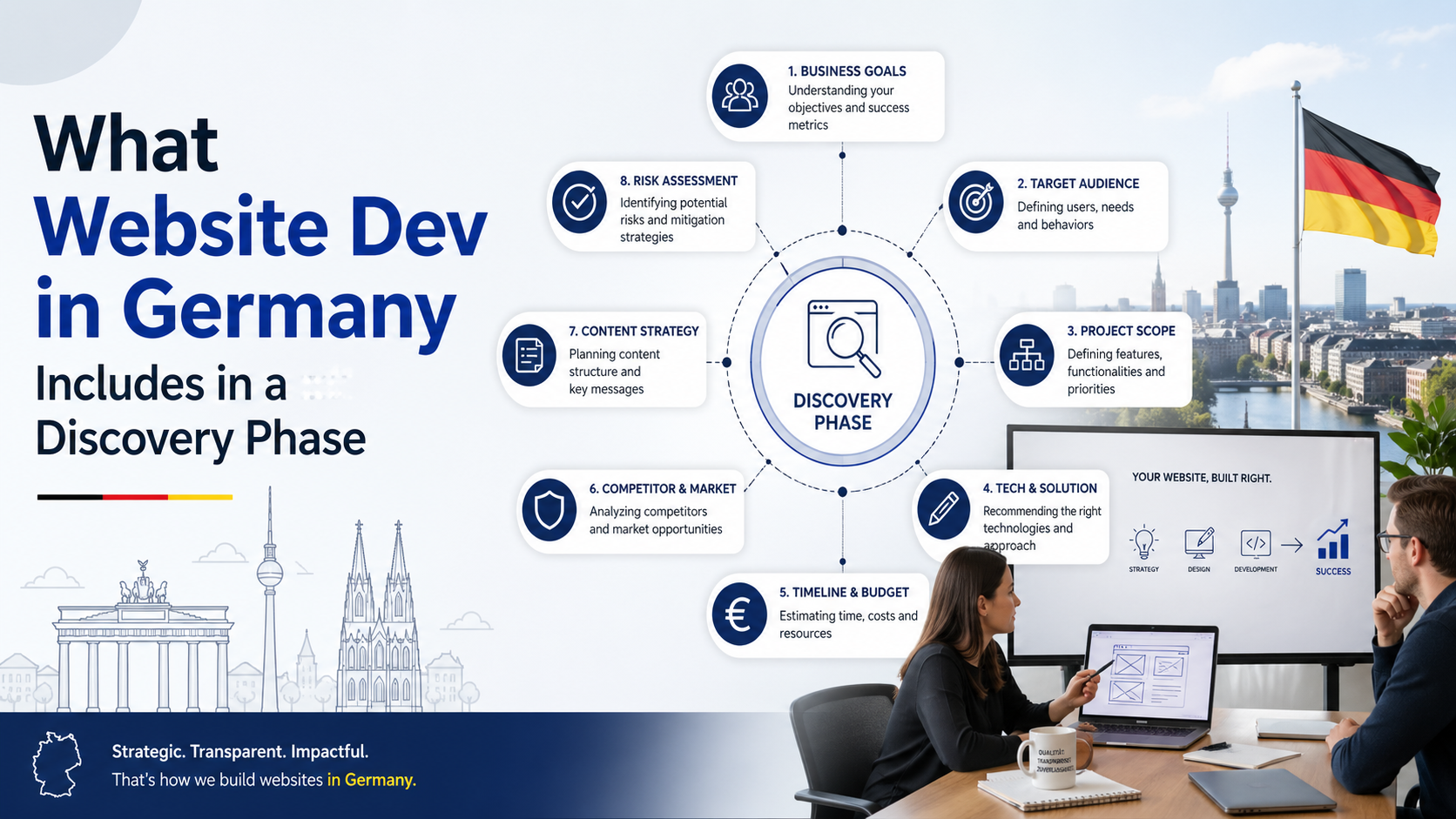
This happens because most agencies skip the one phase that actually protects you: the discovery phase.
I’m a WordPress professional who audits failed projects. When a German business owner comes to me after a bad launch, I can almost guarantee the discovery phase was skipped or done in one rushed meeting.
Let me walk you through what proper website dev in Germany includes before a single line of code is written—and why skipping these steps costs you far more than the initial quote.
A typical agency “discovery” is a 60‑minute call where someone asks:
Then they disappear and return with a design that looks like your competitor’s site—because they never actually understood your business.
For a business owner, this means: You are paying for a guessing game. The agency is designing based on aesthetics, not data. No wonder the final product doesn’t convert.
A real discovery phase starts with understanding why the website exists.
At minimum, a proper project plan outlines site objectives, key audiences, anticipated page layouts, and an environmental scan. But a thorough website dev partner goes deeper.
Key business questions answered before any design:
| Question | Why It Matters |
|---|---|
| What is the primary conversion goal? | Everything else is secondary—layout, navigation, content prioritisation |
| Who are your top three customer personas? | Different users need different paths through the site |
| What are your top five most profitable products/services? | These need prime placement and fastest load times |
| What are the legal requirements for your industry? | In Germany, this is non‑negotiable |
| How will success be measured? | Traffic means nothing. Conversions mean revenue |
What this means in practice: Without documented business requirements, your project has no foundation. Every decision becomes subjective. You change your mind. They change the design. Costs spiral.
A discovery phase produces a list of content requirements, functional requirements, technical requirements, scope of work, project timeline, and post‑launch maintenance plans.
I cannot overstate how important this documentation is.
Most disputes between clients and developers come from undefined assumptions. You assumed “fast website” meant one second load time. They assumed “fast” meant “faster than my previous site”—which was a 5‑second disaster.
Business impact: The scope of work document is your contract extension. Every feature, every page, every technical requirement must be listed. If it’s not in that document, you will pay extra for it later.
This is where website dev in Germany differs from almost every other market.
German law requires:
Additionally, from 19 June 2026, online shops must provide a two‑step electronic cancellation button for online contracts. From 27 September 2026, stricter rules on environmental and sustainability claims will apply.
What this means for you: A missing Impressum is not a small oversight. Competitors in Germany can send and often do send Abmahnungen—formal legal warnings with bills ranging from hundreds to thousands of euros. Your discovery phase must include a legal checklist before any design work begins.
If your business involves selling products online, I strongly recommend reviewing my guide on creating an ecommerce website in Germany legal requirements—it covers the specific obligations for online stores in detail.
Many developers promise speed. Few measure it before starting.
A proper discovery phase runs performance audits on your existing infrastructure—even if you’re rebuilding from scratch. Why? Because the audit reveals what actually slows down users.
Google’s Core Web Vitals guidelines should be referenced before selecting hosting, before choosing a framework, before anything.
When I audit a German business site, I check:
Business impact: Without a baseline, you cannot measure improvement. Your developer might add “optimisation” plugins that actually slow the site down. You need before‑and‑after data. Discovery provides the “before.”
Content is not “fill in the blanks” after design finishes.
A discovery phase includes:
Effective information architecture ensures menus are topic‑based rather than audience‑based, level‑1 menus stay limited to 4‑6 items, and labels remain descriptive without duplicating content paths.
For a business owner, this means: Your navigation should not force users to guess. Topic‑based menus (“Services”, “Products”) outperform audience‑based menus (“For Business”, “For Home”) because most users do not self‑identify elegantly.
Before you approve any website dev proposal, ensure these deliverables are clearly described in writing:
Missing any of these? Your developer is skipping critical work—and you will pay for it later.
A Düsseldorf client came to me after paying €12,000 for an e‑commerce site that never worked properly. The original agency spent one hour on “discovery”, built a site in three weeks, and disappeared when problems appeared.
When I audited the disaster, I found:
The €12,000 site needed €6,000 in fixes just to become functional and compliant. The client paid twice—once for the “cheap” build, once for the professional rebuild.
For a business owner, this means: The discovery phase is not optional administrative work. It is the cheapest insurance you will ever buy. Skipping it is like building a house without a blueprint—technically possible, financially ruinous.
Use these questions to separate professionals from amateurs:
A web development specialist who understands the German market will answer these questions immediately with examples. An amateur will deflect or say “we handle all of that internally.”
If your German website was built without a true discovery phase—or if you are dealing with legal warnings, poor performance, or confusing navigation—this is exactly the type of technical audit I provide for my clients. I do not guess. I document everything, find every gap, and give you a roadmap before writing a single line of code.
You can see my custom WordPress development approach or my WordPress maintenance services for ongoing support. But the real starting point is a discovery audit—before you spend another euro on solutions that miss the actual problems.
Most websites try to impress users. The best ones remove friction. And that difference is what users remember—and what businesses profit from.
Before you approve another proposal, demand a website dev discovery phase with documented requirements, legal compliance checks, performance baselines, and content architecture. Anyone who refuses to provide these deliverables is not protecting your business—they are protecting their ability to cut corners. And in the German market, cutting corners on legal compliance or technical quality will cost you far more than the initial quote ever did.