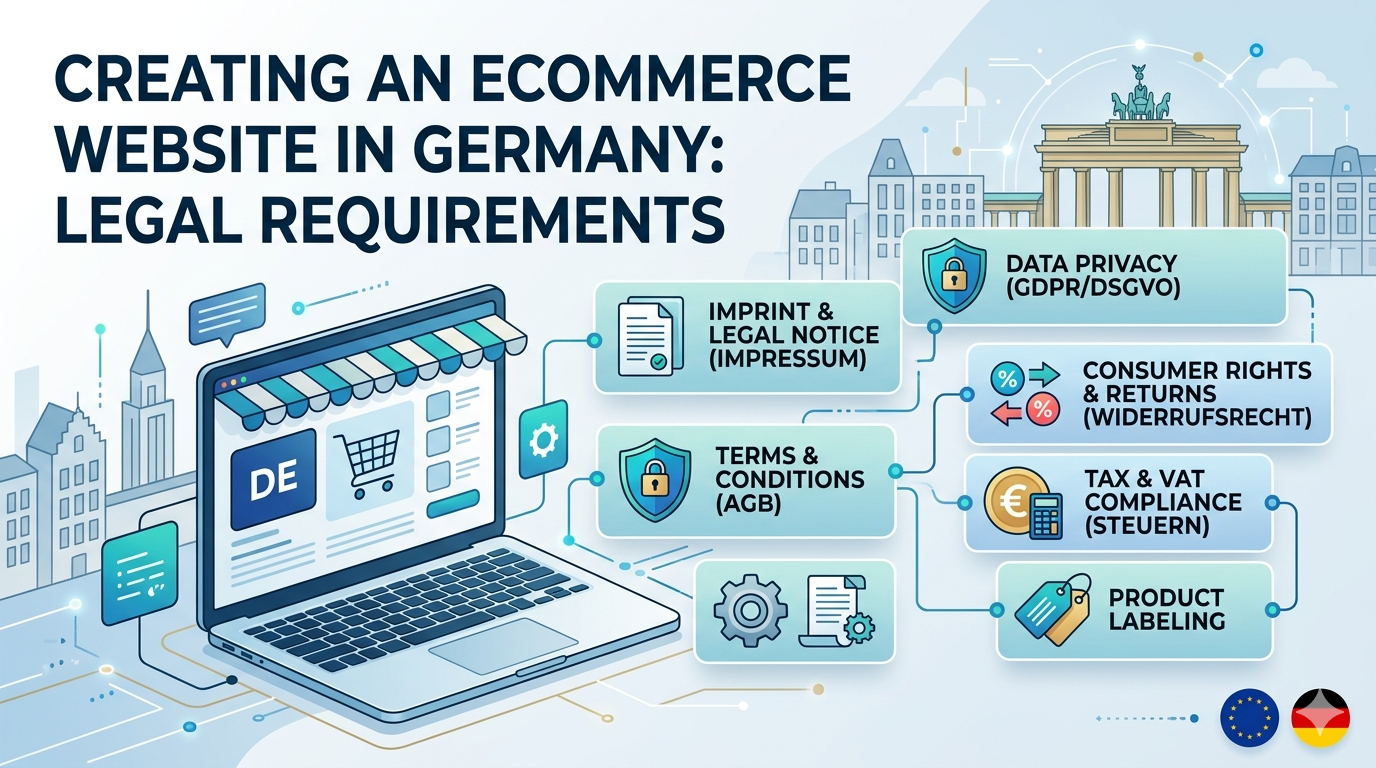
You launch your online shop. Three weeks later, a lawyer’s letter arrives. Seven thousand euros in fines. The reason? Missing Impressum. No cookie banner. Cancellation policy not in the right format.
That’s not bad luck. That’s ignoring what creating an ecommerce website in Germany actually demands before you write a single line of code.
I fix broken websites for a living. And the most expensive breaks aren’t technical — they’re legal. German courts are aggressive. Competitors send Abmahnungen (cease-and-desist letters) as a business model. You need a developer who understands both WooCommerce and the Telemedia Act.
Let me walk you through what a WordPress professional actually checks before a German ecommerce site goes live. No fluff. No theory. Just what works.
Most agencies build the shop first and ask about legal pages later. That’s backwards. In Germany, missing legal texts stop you from selling — not slow performance, not broken images.
I once took over a WooCommerce site for a Berlin-based fashion startup. Their previous team — an agency that “specialised in ecommerce” — had built beautiful product pages but zero legal structure. No Impressum. No data protection declaration. No cancellation instructions.
Business impact: The site had been live for four months. Every order placed in that period was technically voidable by the customer. The founder didn’t sleep for two weeks.
We rebuilt the legal framework in five days. Then fixed the actual sales funnel.
For a business owner, this means: Legal compliance isn’t a checkbox. It’s a revenue protector. Without it, you’re not running a shop — you’re running a liability.
Here’s what creating an ecommerce website in Germany requires — and how a developer implements each piece without breaking your design or speed.
German Telemedia Act (TMG) §5. Every commercial website must have an Impressum — one click from every page. Not hidden. Not in a dropdown. Direct link in the footer.
What a developer does:
What an agency often does:
Sticks a text widget in the footer and calls it done. No schema. No visibility on mobile.
Business translation: If your Impressum takes more than one click to find, you’re already violating German law. A lawyer doesn’t need to prove intent — only inaccessibility.
GDPR isn’t just a banner anymore. For ecommerce, it affects:
What a developer does:
Real example: A client’s shop used a popular German hosting provider with a built‑in cookie banner. The banner only blocked cookies, not the actual script execution. Google Analytics still fired. After fixing, the site passed a third‑party GDPR audit within two hours.
For a business owner, this means: A generic cookie plugin will get you sued. Only a developer who can trace JavaScript execution and WooCommerce hooks can guarantee compliance.
German law requires a clear cancellation instruction for B2C sales. But here’s the technical catch: the cancellation button (Widerrufsbutton) must be directly next to the order completion button.
What a developer does:
What most theme installers do:
They add a text link in the footer or cart page. That’s not enough. The law requires the button (or clearly identifiable link) right before the order is placed.
Business impact: Missing or misplaced Widerrufsbutton means customers can cancel orders even after 14 months. I’ve seen a €12,000 B2B order voided because the shop owner skipped this.
Let me show you a direct comparison. This is what I see when I audit a German ecommerce site built by a “generalist” agency versus a WordPress developer who understands local law.
| Requirement | Agency (Theme Installer) Approach | WordPress Developer Approach |
|---|---|---|
| Impressum | Text widget in footer, no schema | Custom page template, hCard microformat, footer link in theme.json |
| GDPR Script Blocking | Cookie banner that hides but doesn’t block scripts | Server‑side blocking via wp_enqueue_scripts conditional logic + consent API |
| Cancellation Button | Text link in cart page | Custom checkout field with mandatory checkbox confirmation |
| Legal Text Updates | Manually edit pages every time | Centralised custom fields or ACF that populate all legal pages from one source |
| Checkout Data Retention | WooCommerce default (unlimited) | Scheduled wp_schedule_event to anonymise order data after 90 days |
The difference isn’t cosmetic. It’s enforceability. A court doesn’t care if your site looks good. They check if the legal text was accessible and technically correct at the exact moment of order.
Read also: What to Look for in a Website Design Company Near You in Germany
If you already have a shop, run this quick audit:
For a business owner, this means: Your “cheap” development cost isn’t the real price. The real price is legal defence, fines, and lost customer trust.
Not every WordPress developer knows German ecommerce law. Here’s what you ask:
wp_setcookie or a consent API)A WordPress professional will answer without hesitation. A generalist will start googling in front of you.
A client came to me after their previous development team — not me — built a site with:
The result: Two Abmahnungen totalling €3,400. Plus €1,200 to rewrite legal texts. Plus 40 hours of internal team time responding to lawyers.
After I restructured the site — adding proper legal templates, implementing server‑side consent blocking, and moving all legal disclosures above the fold — the same shop processed €87,000 in the next three months without a single legal notice.
Business translation: Legal compliance isn’t a cost. It’s the foundation that allows your marketing and conversion optimisation to actually work.
If your current shop was built without proper Impressum structure, or you’re creating an ecommerce website and want to avoid the standard “fix it later” trap, this is exactly the type of audit and restructuring I provide for my clients. I don’t just install plugins — I rebuild WooCommerce foundations so that legal requirements are baked into the checkout flow, not bolted on after.
You can see how I approach custom WordPress development and WooCommerce setup on my service pages. I also offer ongoing maintenance that includes monthly legal checks — because German laws change, and your site must change with them.
Creating an ecommerce website in Germany without legal precision is like shipping orders without tracking numbers. You might get away with it for a week. Then the complaints start.
Most websites try to impress users with animations and mega‑menus. The best ones remove friction — legal friction, trust friction, compliance friction. And that difference is what users remember — and what businesses profit from.
Build it right from the start. Hire someone who reads the Telemedia Act before they write a single line of CSS. Your lawyer will thank you. So will your bank account.