A medical website usually starts losing enquiries long before the owner notices.
Pages load slowly. Contact forms fail silently. Mobile menus feel awkward. Patients tap “Call Now” and nothing happens. For a clinic, dental practice, physiotherapy centre, or private consultant, these are not minor technical issues. They directly affect bookings.
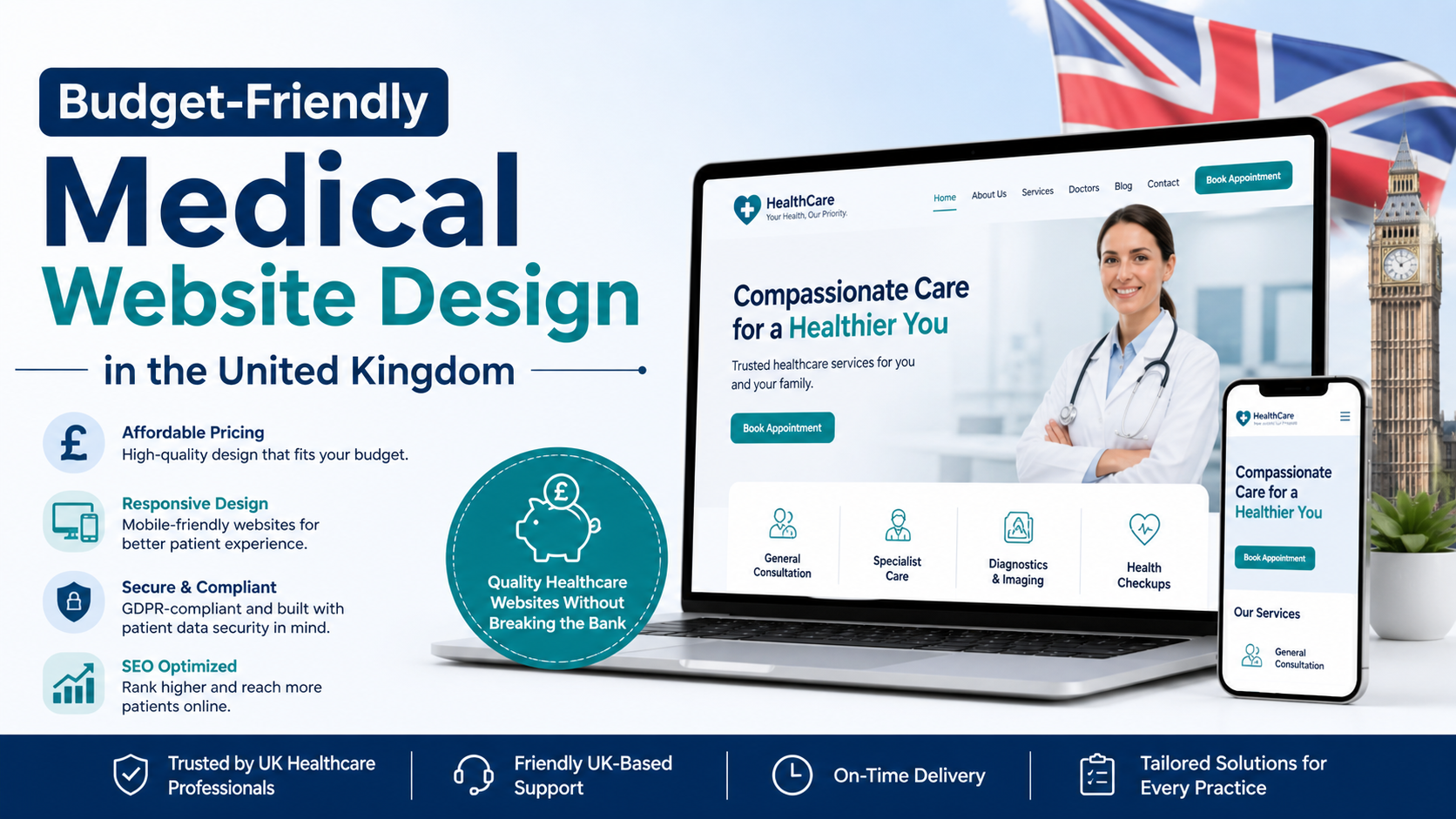
That is why Budget-Friendly Medical Website Design in the United Kingdom is not really about finding the cheapest website. It is about avoiding expensive mistakes that quietly cost you patients.
Most business owners I speak with are not worried about code quality. They care about trust, speed, and whether the site turns visitors into enquiries. That is the correct priority.
A lot of medical websites in the UK are built the same way.
A theme gets installed. A few stock images are uploaded. Several plugins are added to create booking forms, sliders, testimonials, popups, and mobile menus. It looks acceptable at launch.
Six months later, performance drops.
The problem is not WordPress itself. The problem is usually a poorly structured implementation.
For healthcare businesses, that matters more than most sectors. A visitor looking for a GP, dentist, consultant, or therapist is not browsing casually. They want reassurance fast. If the site feels slow or confusing, they leave.
A medical website does not need to impress first. It needs to remove hesitation.
Many agencies sell “design.” What you usually need is better technical decision-making.
| Theme Installer Approach | Developer-Led Approach |
|---|---|
| Adds plugins for every feature | Builds only what is necessary |
| Focuses on visual templates | Focuses on speed, trust, and conversion |
| Uses heavy page builders everywhere | Keeps structure lean and maintainable |
| Little thought about future updates | Plans for updates and long-term stability |
| Fixes symptoms later | Prevents conflicts from the start |
That difference matters because your site is often the first trust signal a patient sees.
A slow clinic website feels risky, even if the practitioner is excellent.
If you recognise two or three of these, your website is probably costing you enquiries.
That is not normal maintenance. That is technical debt.
For performance benchmarks, refer to Google’s Core Web Vitals guidelines—they define exactly how loading speed and interaction delays impact user experience and conversions.
Business owners often assume budget-friendly means cutting corners.
Usually, it means removing unnecessary complexity.
For medical practices, a lean site typically needs only a few things done properly:
That is often more effective than expensive animation, oversized sliders, or plugin-heavy booking systems.
A properly coded navigation system, a clean contact flow, and stable page structure usually outperform “feature-rich” builds.
If you are comparing options, this is why many smaller clinics prefer affordable web design for small business instead of paying for bloated agency packages.
A healthcare client came to me with a WordPress site that looked modern but felt sluggish.
The main issue was not hosting.
The previous team had installed two page builders, multiple font libraries, and three separate plugins trying to handle caching and forms. That created unnecessary script loading and conflicts.
The fix:
The result was immediate. Pages became responsive, and mobile users started completing enquiry forms instead of dropping off.
The business outcome usually comes from reducing friction, not adding features.
Healthcare businesses collect names, emails, phone numbers, and sometimes sensitive patient context.
A neglected WordPress installation becomes an easy target.
You do not need enterprise-grade infrastructure. You need sensible hardening.
WordPress provides a solid baseline in its official hardening guide.
Common issues I see:
A hacked site does not just create downtime. It damages trust.
That is why ongoing WordPress maintenance services usually cost far less than recovery.
Many medical websites ignore accessibility until patients struggle.
For clinics, that is a business problem.
Users may be older, stressed, or navigating on mobile. If buttons are hard to tap or text lacks contrast, they drop off.
The W3C accessibility fundamentals explain why these basics directly affect usability.
Better accessibility = smoother interactions = more completed actions.
Before hiring a WordPress professional, ask:
A real developer explains cause, impact, and business consequence—not just design choices.
Most agencies optimise for handover.
A developer optimises for stability.
That means fewer moving parts, cleaner updates, and faster pages.
If speed is already an issue, this is exactly what I address through my WordPress speed optimization service.
This is where most owners get stuck.
The site looks polished—but doesn’t convert.
If users cannot quickly understand:
then design is not doing its job.
A good medical website reduces decision friction.
If your website feels slow, confusing, or not converting, this is exactly the type of audit and restructuring I provide for my clients.
The real value of Budget-Friendly Medical Website Design in the United Kingdom is not spending less upfront.
It is avoiding the hidden costs of slow pages, plugin conflicts, poor usability, and lost enquiries.
Most websites try to impress users. The best ones remove friction. And that difference is what users remember—and what businesses profit from.
If your site looks fine but underperforms, the issue is rarely visual. It is structural.