Most healthcare websites don’t fail because of design—they fail because they don’t respond when users need them the most.
A patient lands on your site, tries to book an appointment, and the page takes 4 seconds to load. Or worse, the form doesn’t submit. That’s not a design issue. That’s a lost patient.
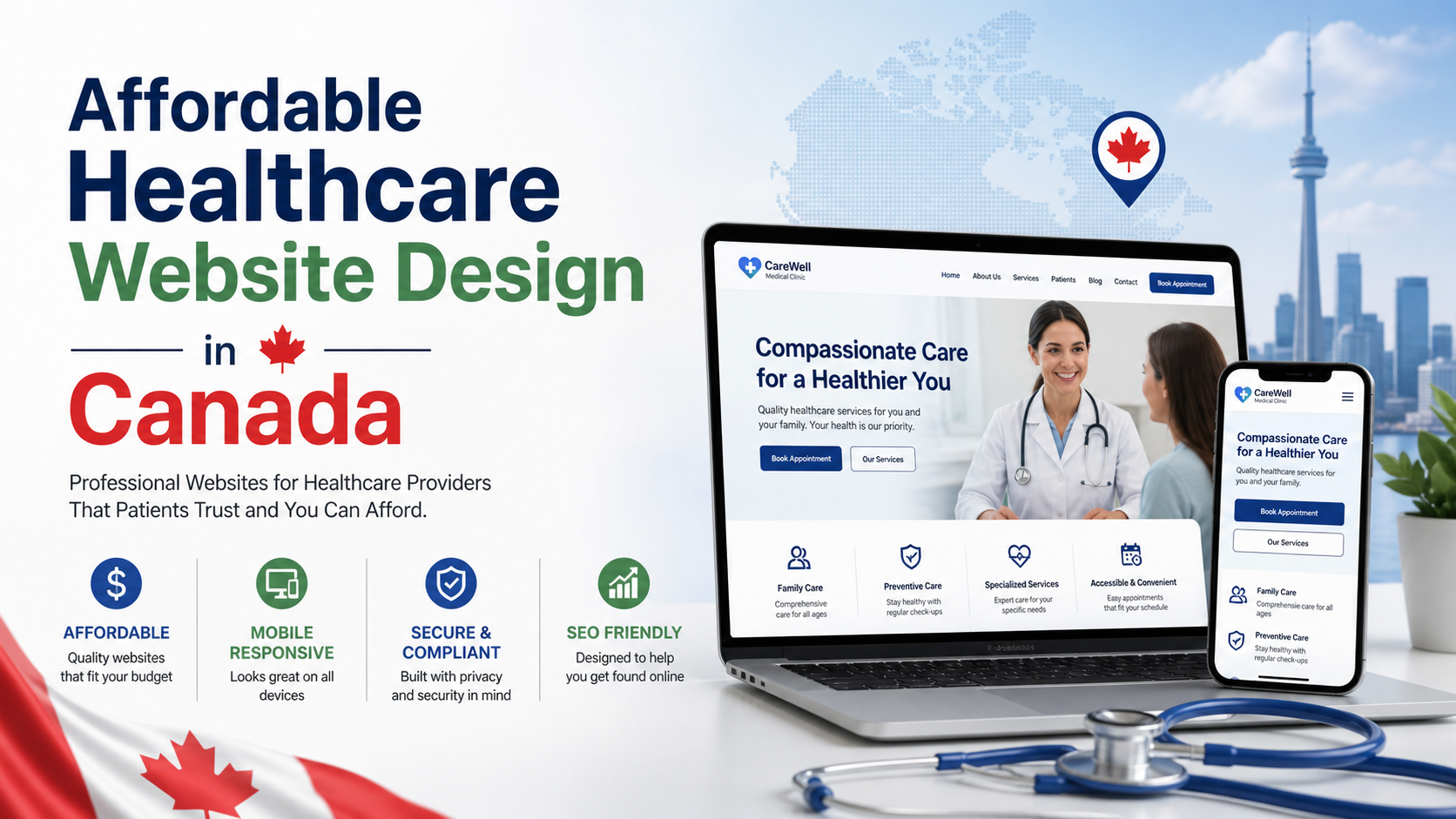
This is exactly where Affordable Healthcare Website Design in Canada needs a shift in thinking—from visual appeal to functional reliability.
There’s a pattern I keep seeing. Business owners invest in a low-cost website expecting a simple online presence, but end up dealing with performance issues within months.
The problem usually comes down to how the site was built.
Instead of structured development, most budget builds rely on:
The result is a site that works initially but degrades quickly.
Affordable doesn’t mean low quality. It means focused development without waste.
Healthcare users are not browsing casually. They are looking for immediate action—booking, calling, or finding information quickly.
If your site is slow, they won’t wait.
According to Google’s performance benchmarks in its Core Web Vitals documentation, load speed and interaction delays directly affect user retention and rankings. You can review these benchmarks in Google’s official Core Web Vitals guidelines.
From a development perspective, real optimization involves:
Speed is not a plugin feature. It’s an architectural decision.
This is where most healthcare websites quietly lose conversions.
A typical poorly built flow looks like this: multiple steps, unclear buttons, mobile layout issues, and sometimes failed submissions.
A properly developed system focuses on:
Every additional click reduces the chance of conversion.
Healthcare websites often handle sensitive user data, yet security is one of the most neglected areas.
Outdated plugins, weak login protection, and poor hosting configurations are common issues.
WordPress itself provides a solid foundation, but it needs proper setup. The official WordPress hardening guide outlines key practices that are often skipped in low-cost builds.
When security is ignored, businesses end up needing reactive fixes like a
my WordPress malware removal service instead of preventing the issue in the first place.
A clinic website came to me with a major issue—slow performance and inconsistent form submissions.
The site was taking around 4.5 seconds to load on mobile.
After reviewing the setup, the problems were clear:
The fix wasn’t complicated, but it required proper implementation.
The result:
No redesign. Just fixing what was already there.
This is where most businesses unknowingly make the wrong decision.
| Aspect | Theme-Based Setup | Developer-Led Build |
|---|---|---|
| Structure | Pre-built demo import | Custom-built for purpose |
| Performance | Slower, bloated | Optimized from start |
| Plugins | Many, often unnecessary | Minimal and intentional |
| Security | Basic | Configured properly |
| Scalability | Limited | Built to grow |
The difference isn’t visual—it’s structural.
If your current healthcare website shows any of these, it’s not functioning efficiently:
These are not minor inconveniences. They directly impact user trust and patient conversion.
A well-built healthcare website focuses on stability, speed, and clarity—not unnecessary features.
Instead of stacking plugins, the focus is on:
For example, performance improvements are handled through structured work like my
WordPress speed optimization service, not by adding multiple overlapping tools.
Before choosing someone for your website, ask direct questions:
Clear answers indicate real experience. Vague answers usually lead to long-term issues.
If your website feels slow, unstable, or not converting, rebuilding is not always necessary.
In many cases, restructuring the existing setup delivers better results.
If your website feels underperforming, this is exactly the type of audit and improvement I handle—whether it’s performance fixes, security cleanup, or ongoing stability through WordPress maintenance services.
Affordable Healthcare Website Design in Canada is not about lowering cost—it’s about eliminating inefficiency.
A website that loads fast, works reliably, and guides users clearly will always outperform a visually impressive but poorly built one.
Most websites try to impress users. The best ones remove friction. And that difference is what users remember—and what businesses profit from.