Your website loads slowly during a flash sale. The checkout page crashes when twenty people are on it. Or you wake up to a “critical error” email and zero sales for six hours.
You’ve already paid someone to “fix” this. They added more plugins. They told you to upgrade hosting. Nothing changed.
When business owners ask me about backend web development in India, they rarely care about programming languages. They care about downtime. Lost orders. Why their competitor’s site feels faster despite cheaper hosting.
I’m a WordPress developer who audits broken sites daily. Let me walk you through what actually matters on the backend—and what you should demand from your technical partner.
Most agencies sell you a fancy frontend: animations, sliders, full‑screen videos. But the backend is where revenue lives or dies.
Every time a user clicks “Add to Cart” or submits a contact form, the backend processes the request. It queries the database, runs PHP code, fetches data, and returns a response. If that chain takes more than 2.5 seconds, Google will lower your ranking. More importantly, users will leave.
For a business owner, this means: Your beautiful design means nothing if the backend takes three seconds to respond. Every extra 100ms on load time directly reduces conversion rates. I’ve seen 1.9‑second stores outsell 3.5‑second competitors with identical products.
A client came to me with a WooCommerce site taking 4.2 seconds to load. The previous team had installed three caching plugins that conflicted with each other. The database had 48,000 autoloaded options—many from abandoned plugins. PHP memory was capped at 64MB, causing constant crashes.
After removing plugin conflicts, optimizing the database, setting a proper memory limit, and deferring render‑blocking scripts, the site loaded in 1.1 seconds. The client saw a 23% increase in add‑to‑cart rate within two weeks—without changing a single product image or headline.
You don’t need to learn coding. But you should know what your development team is—or isn’t—using.
Over 43% of the web runs on WordPress. That means PHP powers millions of business sites in India. A competent WordPress developer knows how to write efficient PHP—not just copy‑paste from tutorials.
What poor PHP looks like: Ten plugins each loading their own jQuery version. Direct database queries inside theme files. No use of transients for caching API calls.
For a business owner, this means: A developer who doesn’t understand PHP will build a site that breaks after every WordPress update. You’ll pay for constant “emergency fixes” instead of growing your business.
If you run a chat support system, live dashboard, or collaborative tool, Node.js handles concurrent connections better than PHP. But for 90% of small business sites (brochure sites, e‑commerce stores, membership portals), Node.js adds unnecessary complexity.
What this means in practice: Don’t let a developer sell you a Node.js rewrite just because it sounds modern. Start with PHP on optimized infrastructure. Only move to Node.js if you have proven scale or real‑time requirements that PHP cannot meet.
Python (with Django or Flask) works well for data‑heavy applications, AI integrations, or custom internal tools. But I’ve seen agencies force Python into standard brochure sites—then charge triple for maintenance because finding a Python developer in smaller Indian cities is harder than finding a PHP developer.
Business impact: Your technology choice directly affects your ongoing costs. PHP developers are widely available in India. Python specialists are rarer and more expensive. Choose what your business actually needs, not what sounds impressive in a pitch deck.
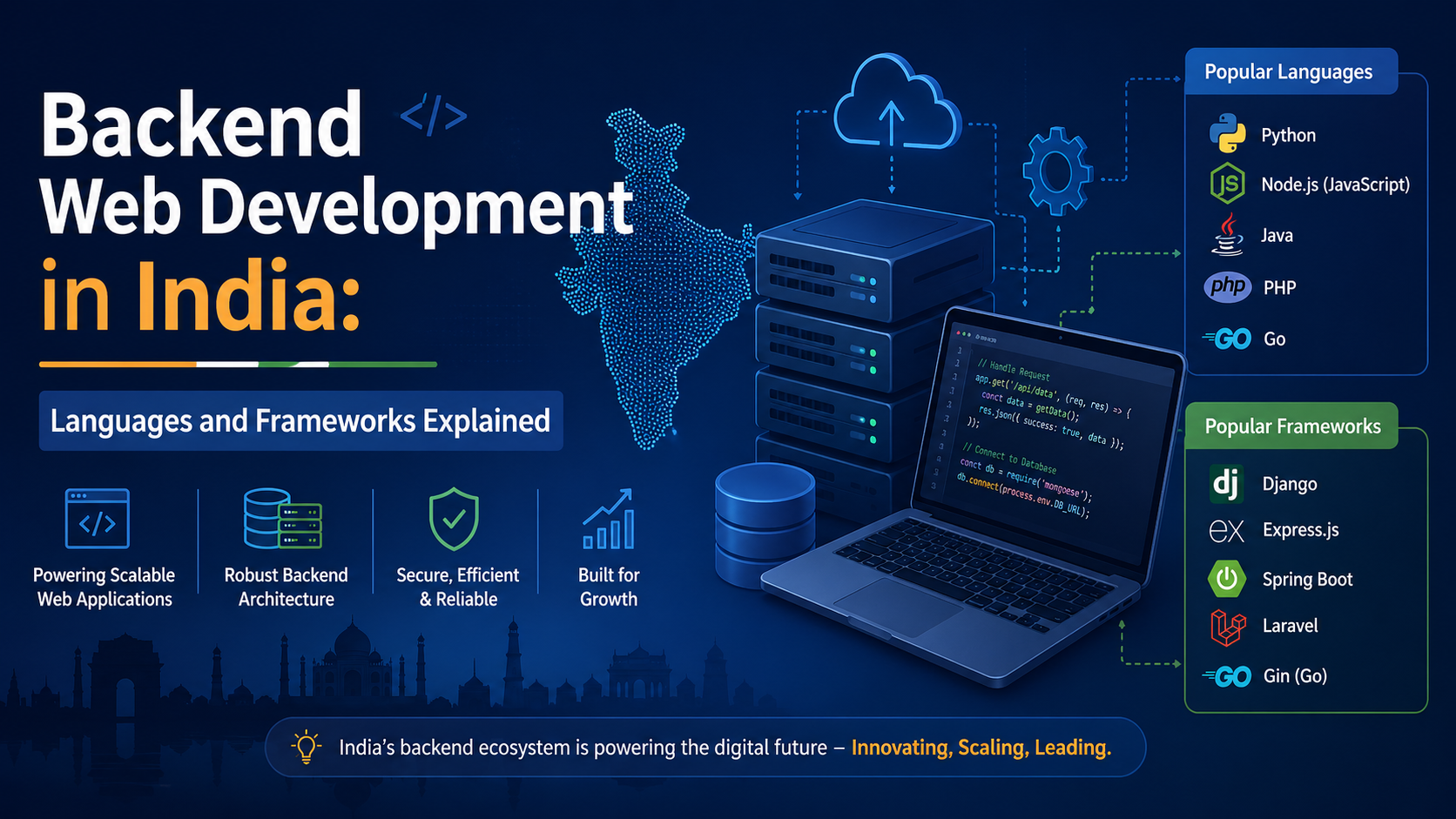
A framework is not a magic solution. It’s a set of conventions. Here’s how different player approach backend web development in India:
| Approach | Performance Handling | Security | Scalability | Maintenance Cost |
|---|---|---|---|---|
| Theme installer (buys a $59 theme) | No caching strategy; slow database queries | Relies on theme updates; no custom hardening | Breaks at 50 concurrent users | High – constant plugin conflicts |
| WordPress developer (custom build) | Optimized queries; object caching; CDN integration | Role hardening; login limiting; routine audits | Handles 500+ concurrent users | Low – clean code is easy to update |
| Laravel specialist | Great for web apps; over‑engineered for simple sites | Excellent if coded properly | Very high but costly | Medium to High – specialist required |
A good web development specialist will not lock you into a framework just because it’s trending. They will ask about your traffic, budget, and feature roadmap first.
For a business owner, this means: You are not saving money by hiring cheap. You are accumulating technical debt that will cost 3–5x more to fix later. I clean up these sites regularly—and the bill is never small.
A hacked site costs an average of ₹80,000 to ₹2,00,000 in direct losses (restoration, lost sales, brand damage). Yet most “affordable” developers skip basic security.
I follow the WordPress.org hardening guide for every build. That means moving wp-config.php outside the web root, disabling file editing in the dashboard, setting proper file permissions, and implementing login rate limiting.
What this means in practice: A secure backend is not a luxury. It’s a baseline. If your development team cannot explain how they handle SQL injection or cross‑site scripting, find another partner immediately.
Google’s Core Web Vitals guidelines are not optional. Starting May 2025 (and already enforced via ranking signals), poor backend performance will push your site to page two.
Speed optimization starts at the server level. PHP 8.x instead of PHP 7.4 gives you a 20–30% performance boost instantly. Proper MySQL indexing cuts query time from 500ms to 15ms. A correctly tuned php.ini—especially the memory_limit setting (PHP official docs)—prevents random crashes.
For a business owner, this means: You don’t need “miraculous” speed plugins. You need a developer who configures the stack correctly. One hour of backend tuning often outperforms six months of frontend tweaks.
A slow backend will ruin even the most responsive frontend design. I go deeper into this in my article on what responsive web development in India means for mobile users – but the core principle is the same: backend speed is the foundation. Without it, nothing else works.
If your website feels slow, breaks under moderate traffic, or has been hacked more than once, this is exactly the type of audit and restructuring I provide for my clients. I don’t add plugins to fix plugin problems. I rebuild the backend properly.
You can see my WordPress speed optimization service or my malware removal service for specific cases. But the real solution is often a full backend audit—which I do as part of my custom WordPress development.
Most websites try to impress users. The best ones remove friction. And that difference is what users remember—and what businesses profit from.
Stop chasing “full stack” buzzwords and framework trends. Find a backend web development partner in India who understands PHP, database optimization, and security hardening—not someone who sells page builders as “enterprise solutions.” Your conversion rate depends on it.