Most UK business owners I speak with started their ecommerce site development journey by typing “best platform” into a search bar. They read four comparison articles, signed up for a free trial, and built something that looked passable. Six months later, they’re on the phone with me because the site can’t handle a VAT‑exempt B2B order flow, the checkout loads in 4.7 seconds on a 5G connection, and they’ve just discovered that adding a simple custom shipping rule requires a £30/month plugin on top of a platform fee that already feels too high.
The platform you pick isn’t a one‑time decision. It defines what you can change without rebuilding, how much control you have over performance, and who ultimately owns the data your business runs on. If you’re evaluating ecommerce site development in the UK right now, I’m going to walk you through the comparison that actually matters—the one seen from the database, not from the demo video.
Every mainstream e‑commerce platform can display products, take payments, and send order confirmation emails. What separates them is what happens when your business model doesn’t fit the default flow. That’s where a technical partner who understands the server‑side trade‑offs becomes worth far more than a feature checklist.
I work primarily with WooCommerce because it grants full access to the server, the database, and the codebase—the three layers that determine whether a site converts or crumbles under growth. But I’ve also extracted businesses from WooCommerce when a fully managed solution genuinely fit them better. There’s no universal answer, only a correct architectural fit for your specific revenue logic.
For a business owner, this means the platform decision should be made by someone who understands both your commercial requirements and the underlying technology—not by whoever has the flashiest affiliate marketing.
A UK‑based wholesaler came to me after two years on a popular hosted platform. They sold both to consumers and to trade buyers with 30‑day payment terms, tiered pricing, and VAT‑handling that depended on whether the buyer was B2B or B2C. The hosted platform’s native checkout couldn’t split those flows cleanly. The workaround involved three third‑party apps, two of which conflicted during the cart calculation, occasionally showing B2C prices to trade buyers. The site also loaded nearly 90 external scripts on the checkout page—most from those apps—dragging the time‑to‑interactive past 5 seconds.
Cause: The platform’s architecture treated every store as a simple B2C shop. Customisation was limited to app‑layer bolt‑ons, each adding JavaScript, server calls, and a recurring fee.
Fix: We migrated the catalog, customer records, and order history to a clean WooCommerce install on a properly configured UK hosting environment. I wrote a lightweight custom plugin that handled the split pricing, trade‑account logic, and VAT display without any external API calls. The checkout page dropped from 87 scripts to 11 core ones, with everything non‑critical deferred.
Outcome: The checkout load time fell to 1.3 seconds. The error rate on trade pricing went to zero. The client’s monthly platform and app costs dropped by 62%, and their trade‑account conversion rate climbed by 21% in eight weeks.
This is not a rare outcome. It’s what happens when ecommerce site development serves the business logic instead of forcing the business to fit the software.
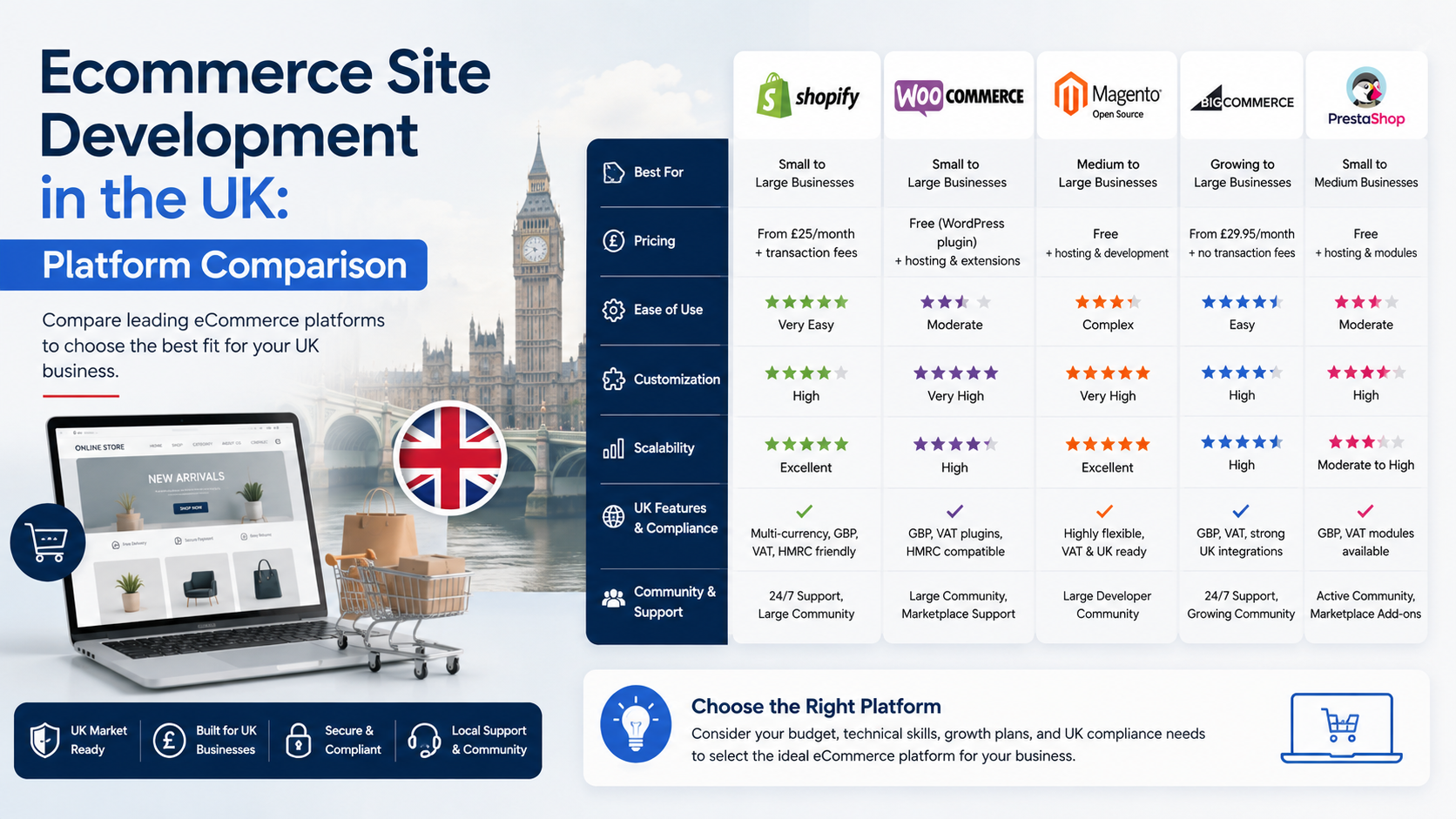
Below is a comparison of the three platforms most UK merchants evaluate. I’m not comparing feature lists. I’m comparing what determines long‑term cost, speed, and agility.
| Criteria | Hosted Solution (Shopify) | WooCommerce (Self‑Hosted) | Magento / Adobe Commerce |
|---|---|---|---|
| Ownership and data control | You rent the store. Data is portable but the front‑end, checkout, and logic stay with the platform. | You own everything—database, files, server. You can migrate, clone, or modify any part. | Same full ownership, but with higher complexity and hosting requirements. |
| Customisation depth | Limited to the templating language and approved APIs. Complex B2B or mixed‑cart logic requires external apps. | Unlimited. You can modify the entire checkout flow, database queries, and integration layer with custom PHP. | Deeply customisable, but changes require certified developers and rigorous testing. |
| Ongoing cost trajectory | Monthly subscription plus transaction fees plus app subscriptions. Costs scale with volume and complexity. | Hosting, domain, SSL, and developer time. No transaction fees beyond your payment gateway. Total cost often decreases as you optimise. | Enterprise licensing, specialised hosting, and certified development. High floor, high capability. |
| Performance responsibility | Platform optimises the core. App scripts and unoptimised images still slow your store, and you have limited server‑level control. | Full control over caching, asset delivery, and database structure. A developer can achieve sub‑1.5‑second loads consistently, as guided by Core Web Vitals. | Extremely high performance potential, but requires a skilled ops team and significant server resources. |
| Security model | Platform secures the infrastructure. Your account security and installed apps are your responsibility. | You’re responsible for the entire stack. A hardened setup following WooCommerce security best practices and proper file permissions makes it as secure as your diligence. | Enterprise‑grade security, but the attack surface is large. Constant patching is mandatory. |
In simple terms: Hosted platforms reduce initial complexity at the cost of long‑term control. Self‑hosted solutions like WooCommerce require a development team that knows hardening and optimisation, but they return that investment through lower ongoing costs, better performance, and the ability to say “yes” to any business requirement.
You don’t need a migration to realise there’s a problem. I regularly see these indicators during audits.
What this means in practice: If any of these points sound familiar, your ecommerce site development wasn’t built for growth. It was built for launch.
Whether you’re building fresh or replatforming, the following questions will surface whether the person across the table can actually deliver a site that earns, not just one that exists.
You might be reading this because the platform you picked two years ago now feels like the thing holding you back. The site works, but every change costs too much. The checkout is slow, and you’re not confident the data is clean. You’ve outgrown the demo.
If your e‑commerce site feels like a constant negotiation with your own software, this is exactly the type of audit and restructuring I provide for my clients. I don’t push migrations unless the math is clear. I start with a technical audit that tells you what’s fixable and what’s broken. For WooCommerce stores, that often leads to the kind of optimisation I handle through my WooCommerce developer service and the performance work that turns a heavy checkout into a revenue engine. And when the platform itself is the problem, I map out a migration path that preserves your SEO and order history while removing every bottleneck the old system imposed.
I work with UK businesses remotely under the same principle: documented process, transparent reasoning, and technical decisions that always tie back to margin. After the rebuild, structured maintenance keeps the site fast, updated, and monitored—whether you’re in Manchester or Mumbai.
When your e‑commerce site is built on the right technical foundation, your customers never wonder what CMS it runs on. They search, they find, they buy, and they trust. They don’t care about your tech stack. They care that the price displays correctly, the checkout doesn’t stall, and their invoice arrives instantly. The best ecommerce site development makes the platform invisible and the transaction effortless.
Most websites try to impress users. The best ones remove friction. And that difference is what users remember—and what businesses profit from. Pick the platform that lets you remove the most friction, not the one that looks the most polished in a 30‑second demo video.