A Dubai‑based business owner once told me he chose a developer because the quote was AED 4,500 for a full WooCommerce site. He thought he’d found a bargain. Eight months later, the site couldn’t handle 15 concurrent users during a flash sale. The checkout collapsed. The hosting bill had tripled because the server kept hitting its memory ceiling. And the “developer” had vanished after the final payment, leaving behind 53 active plugins—including two with known vulnerabilities that had been abandoned by their authors two years prior.
The AED 4,500 quote wasn’t cheap. It was expensive in ways that didn’t appear on the invoice.
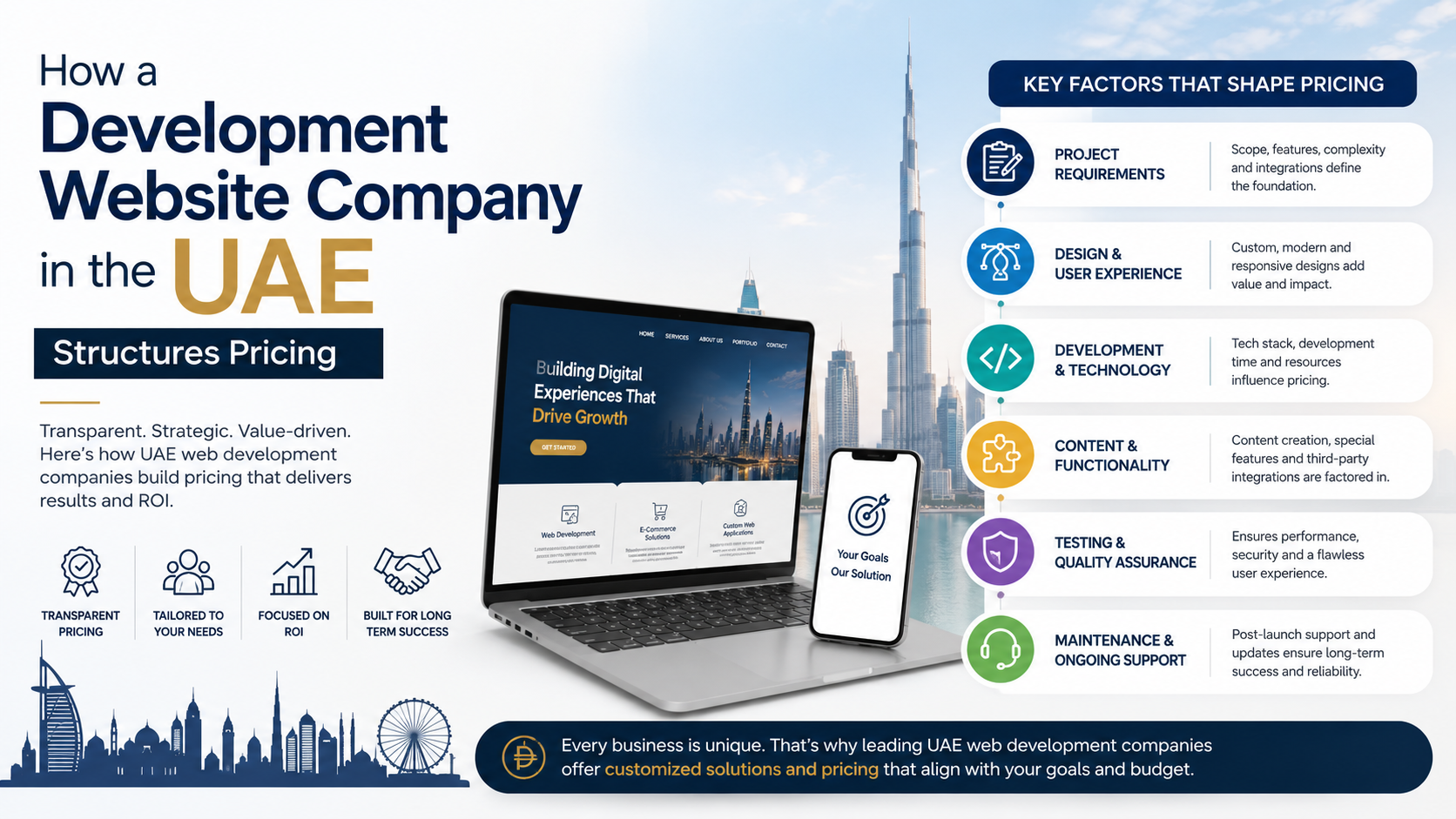
How a development website company in the UAE prices its work is never just about the number on the proposal. The pricing model itself defines what kind of site you’ll end up with, how long it’ll survive under real business pressure, and whether you’ll own an asset or rent a ticking liability. I’ve rebuilt enough of these “budget” projects to know that the structure of the deal matters as much as the talent behind it.
If you’re evaluating a development website company right now, I’ll show you how the different pricing models work, what each one reveals about the developer’s incentives, and how to spot a quote that looks reasonable but will cost you twice before the year is out.
Every pricing model carries an invisible incentive. A developer might not even articulate it, but the way they get paid shapes the way they build. Understanding this is the difference between hiring someone who wants to finish the project and someone who wants the site to perform long after launch.
Most small and medium businesses gravitate toward fixed‑price quotes because the number feels final. The proposal says AED 12,000, and you believe that’s the end of the spending. I’ve rarely seen a fixed‑price WordPress project stay within the original scope. Not because developers are dishonest, but because the incentive is to deliver the minimum viable interpretation of the requirements and move on.
Under a fixed‑price agreement, every extra request becomes a “change order” with a new cost. And the developer’s margin depends on completing the site quickly, which often means choosing the fastest path, not the best one. Install a multipurpose theme instead of building a lightweight front‑end. Add a plugin for every feature instead of writing clean, minimal custom code. Skip database optimisation because the client won’t notice until month six. The end result looks complete on launch day, but under the hood, it’s a stack of shortcuts that will slow down, bloat, and expose itself the moment the business scales.
For a business owner, this means fixed‑price gives you a cap on initial spend, but it removes the developer’s incentive to build for the long term. You pay less upfront and more later, usually in emergency fixes.
Some development website company teams price by the hour. This sounds transparent: you only pay for the work done. But hourly billing puts the risk of efficiency on you. If a developer spends four hours debugging a conflict that someone with more experience would solve in 30 minutes, you absorb that cost. And there’s a subtle, uncomfortable tension: the developer earns more when the work takes longer. Even with honest intentions, that’s not a dynamic that naturally produces lean, fast output.
Hourly work works best when the scope is genuinely unknown—like a malware forensics investigation or a complex third‑party API integration. But for building a site from scratch or maintaining an existing one, pure hourly billing rarely aligns the developer’s interest with yours. You want the site finished, stable, and fast. The meter keeps running either way.
In simple terms: Hourly billing makes you the project manager. If you can’t verify whether four hours was the right amount of time for a task, you’re paying blind.
The model I use with long‑term clients is structured around ownership, not hours. A monthly retainer covers a defined set of responsibilities—performance monitoring, security hardening, updates tested in staging, database optimisation, and priority development time for new features. The client pays a flat fee, and my incentive is to keep the site so well‑maintained that emergencies don’t happen. If I’m constantly firefighting, my margin erodes. So I build and maintain with the kind of diligence that prevents firefighting in the first place.
This model is what a serious technical partner offers. It’s not about clocking minutes; it’s about ensuring the site converts, stays secure, and never surprises you. In a retainer relationship, the developer’s goal and the business owner’s goal are finally the same: a stable, fast, revenue‑generating website that nobody has to panic about.
Business impact: Retainers replace unpredictable emergency costs with a predictable operating expense, and they fund proactive work rather than reactive patching. Over 18 months, they almost always cost less than the fixed‑price‑plus‑emergencies cycle.
A client in Abu Dhabi came to me after their “budget” WooCommerce site crashed during a product launch. The site had been built for AED 5,000 under a fixed‑price contract by a freelancer who had since become unresponsive. When I ran the initial audit, this is what I found:
The cause: The freelancer had installed a pre‑built theme with over 60 bundled plugins, only 18 of which were actually needed. The unused plugins were still active and loading scripts on every page. The server was running on a shared hosting plan with a default 128 MB PHP memory limit, which the site regularly exceeded during any cart operation involving more than two items. Product images were 2–4 MB PNGs, unoptimised. And the database contained 22,000 autoloaded rows in the wp_options table, bloated by a page builder that stored revision data in the wrong place.
The fix: I stripped the site down to the essential 16 plugins and deactivated everything else. I migrated it to a properly configured cloud server and set the PHP memory limit to a stable 256 MB—enough for WooCommerce’s normal overhead, as any competent web development specialist knows from consulting the PHP memory limit documentation. I rebuilt the front‑end on a minimal child theme, optimised all images to WebP, deferred every non‑critical script, and cleaned the database of the revision bloat. I also hardened the server following principles from the WordPress.org hardening guide, which the original developer had completely ignored—the wp‑content/uploads directory was executing PHP without restriction.
The outcome: The site loaded in 1.2 seconds on a standard mobile connection. The checkout stopped breaking under load. The monthly hosting cost dropped by 40% because the optimised server no longer needed constant resource overprovisioning. The client’s first flash sale after the rebuild processed 85 concurrent checkouts without a hiccup.
The AED 5,000 site ultimately cost nearly four times that amount to fix. And that doesn’t include the revenue lost during the launch failure. The pricing structure didn’t just produce a weak product—it produced a liability. This is why I encourage businesses to look at custom WordPress development that’s built for their specific revenue logic, not a demo that’s been hastily adapted.
When you receive a quote from any development website company in the UAE, the line items matter. A proposal that just says “E‑commerce website: AED 12,000” without breaking down what that actually buys you is a proposal that’s expecting you not to ask. Here’s what a developer‑grade proposal should specify.
What this means in practice: A detailed proposal isn’t just paperwork. It’s evidence that the developer has thought through the consequences of their build decisions and isn’t planning to disappear the moment the final invoice clears.
For a business owner, this means if the proposal looks like a product listing rather than a service agreement, you’re probably buying a template installation, not a business asset.
When I’m on the other side of the table—as a client evaluating a technical decision—these are the questions I ask. They don’t require technical knowledge to understand the answers; they just require listening for depth.
You might be reading this because you’ve already received a quote that feels suspiciously low, or because you’re living with a site that was built cheap and now feels fragile. The checkout stutters. Mobile pages take four seconds to paint. You’re not confident the security layer would survive a deliberate attack. You don’t have a developer you can call who knows the site inside out.
If your website feels like it was built to be delivered, not to perform, this is exactly the type of audit and restructuring I provide for my clients. I don’t sell fixed‑price boxes. I start with a full technical audit—the kind that reveals every plugin conflict, database bloat, security gap, and performance bottleneck—and then I build or fix what’s actually broken. That might mean a performance overhaul through my speed optimization service, or it might mean a ground‑up custom build where every line of code exists to serve a specific business function, not just to fill a demo template.
I work with UAE‑based businesses remotely, and the relationship works because the pricing is transparent, the scope is clear, and the accountability is continuous. You don’t need someone in the same city. You need someone who treats your site like it’s the engine of your revenue—because it is.
The number on a proposal is only one part of the cost. The real cost of a website is what you pay to build it, plus what you pay to fix it, plus the revenue you lose while it’s broken. A development website company that prices its work around ownership and outcomes, rather than around tasks and hours, removes the second two variables almost entirely. You pay once, properly, and the site earns.
Most websites try to impress users. The best ones remove friction. And that difference is what users remember—and what businesses profit from. A fairly priced, professionally built site doesn’t just remove friction for your customers. It removes friction from your operations, your security posture, and your sleep. That’s the pricing structure that actually delivers value—long after the invoice is forgotten.