I spoke with a business owner in Austin last month. He had hired three separate specialists over 18 months: one for hosting setup, one for “speed optimization,” and another for a malware clean‑up. He paid $3,700 total. The site was still loading in 4.1 seconds. The database hadn’t been optimised. And nobody had touched the plugin stack that was eating 280 MB of server memory with every uncached page load.
Buying services in web development one slice at a time feels economical. You pay only for what you need, when you need it. In practice, you end up paying three different people to fix symptoms while the underlying structural problems compound untouched. Each provider works within their narrow task, and nobody audits the whole system. That’s not a saving—that’s deferred cost accumulating interest.
I’m a WordPress developer who audits these fragmented sites. I see where à la carte thinking leaves gaping holes that directly hurt conversions, search visibility, and customer trust. If you’re weighing how to buy services in web development for your USA‑based business, I’ll show you what real technical ownership looks like versus a patchwork of one‑time fixes.
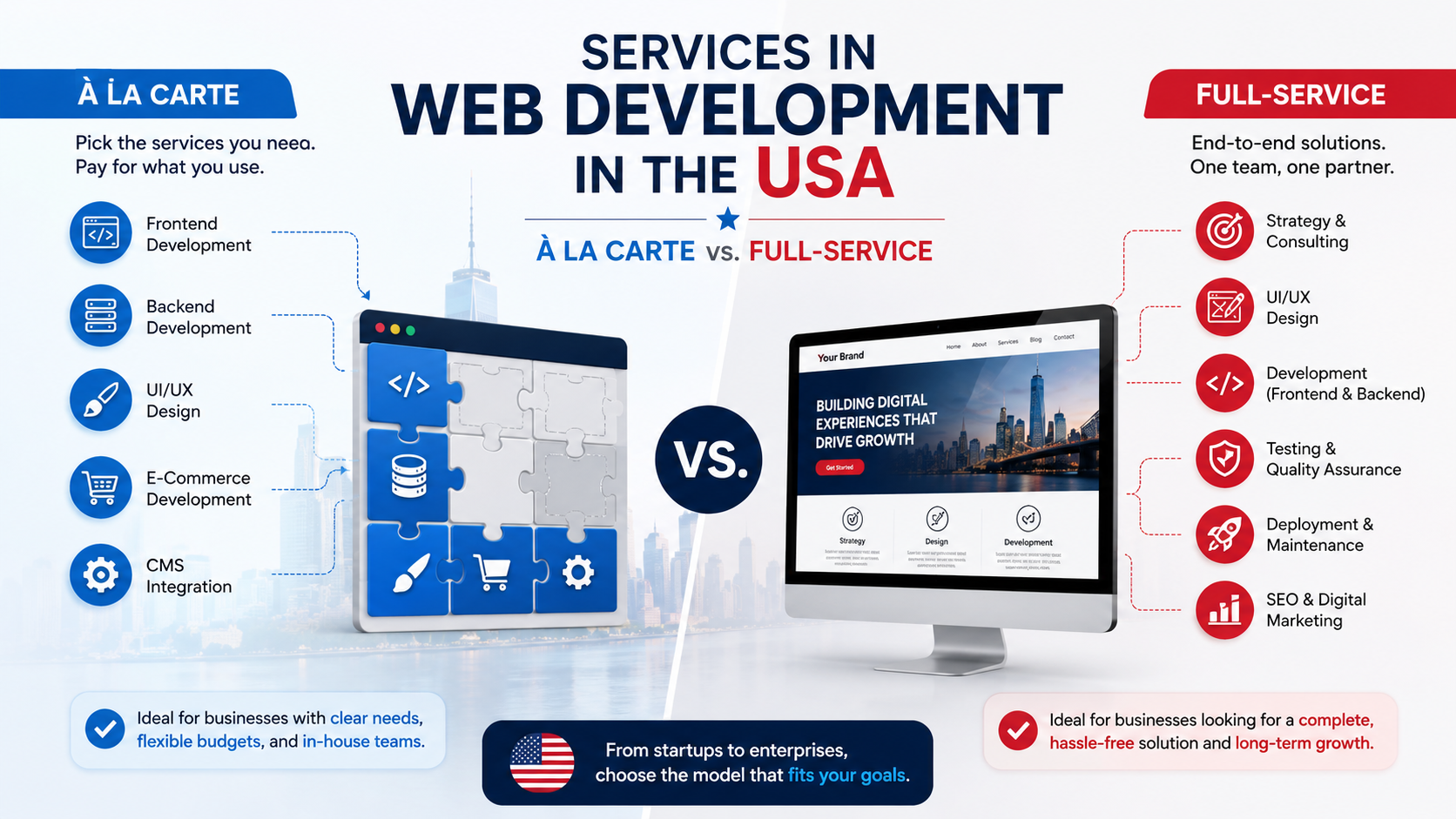
Most business owners think à la carte means ordering exactly what you need. In web development, it usually means you act as your own project manager across three to five different contractors who never speak to each other. One handles your DNS. Another tweaks your theme. A third installed a security plugin eight months ago and hasn’t logged in since.
Each person does their task. But nobody checks whether the security plugin is clashing with the caching layer the speed person set up. Nobody notices that the custom‑coded contact form bypasses your CDN and loads an unminified 190 KB script on every page. And nobody feels responsible for the whole machine.
For a business owner, this means you’re paying individual line items while the site’s overall health, performance, and security degrade in the gaps between them.
When I take on a client under a full‑service approach, my responsibility isn’t a single deliverable. It’s the outcome: a site that loads fast, stays secure, captures leads reliably, and doesn’t produce unpleasant surprises. That requires auditing across all layers—server, application, database, and integration—not just completing a ticket that says “install caching plugin.”
A full‑service development team (or an experienced individual developer) maintains a mental model of your entire stack. We know which plugins are active, which ones are truly needed, what the database looks like under the hood, and where your performance bottlenecks actually live. When a WordPress core update rolls out, we don’t just click “update” and hope—we test in a staging environment because we know your custom checkout flow relies on a specific hook that might break.
In simple terms: Full‑service isn’t about bundling services for a higher price. It’s about continuity of ownership. Someone who knows your site well enough to prevent problems instead of just reacting to them.
A client in Chicago came to me after a frustrating year of piecemeal work. They had hired:
Total spent: $4,800. When I first loaded the site, it took 5.2 seconds to show product pages. The database had 14,000 orphaned rows from plugins uninstalled months ago. The security breach had returned—the original backdoor was never fully removed, just the visible malware payload. And the custom quote calculator was loading its JavaScript on every page, including the homepage, because nobody had conditional loading logic.
The root cause wasn’t any single provider’s incompetence. It was the absence of anyone who owned the whole picture.
I spent two weeks rebuilding the site on a clean, hardened installation. I kept the quote calculator functionality but wrote it into a custom plugin with proper asset loading—only on the pages that needed it. I cleaned the database, set up file‑integrity monitoring, and configured a single, server‑level caching system that didn’t fight itself. The site dropped to 1.4 seconds. Malware never returned. The client stopped receiving “urgent fix” invoices.
Business impact: The client’s monthly cost stabilised under a structured maintenance plan. Their mobile conversion rate climbed 17%. And they never again had to explain to a customer why the checkout page was displaying a “your connection is not private” warning.
A single task‑based service rarely looks beyond the scope of the invoice. Below is a comparison of what gets attention in each model.
| Area of Responsibility | À La Carte (Task‑Based) | Full‑Service (Ongoing Ownership) |
|---|---|---|
| Performance | Installs a caching plugin, compresses some images, leaves. Doesn’t check if the cache is clearing on every page load. | Audits the full request waterfall, defers render‑blocking scripts, removes unused CSS, optimises the database, and aligns with Core Web Vitals thresholds. Monitors performance over time. |
| Security | Runs a malware scanner, removes flagged files. Doesn’t close the entry point or harden file permissions. | Hardens the server and application layers following WordPress.org’s hardening guide. Implements file‑integrity monitoring, login protection, and regular permission audits. |
| Plugin management | Nothing, unless a plugin breaks and you pay for a fix. | Regularly audits all plugins, removes unused ones, tests updates in staging, and writes custom micro‑code to replace heavy or abandoned plugins. |
| Database health | Not addressed. The site slows down over time and nobody knows why. | Cleans post revisions, removes orphaned meta, optimises autoloaded data, and keeps query counts low. |
| Updates (core, theme, plugins) | You click update and pray, or you don’t update at all. Both are dangerous. | Tested in staging first. Rolled out with a rollback plan. Developer accountable if something breaks. |
| Integration logic | Each integration is a separate project. Nobody checks if one custom script conflicts with another. | All custom code is written with awareness of the full stack. Scripts load conditionally, not globally. No conflicts accumulate. |
What this means in practice: Full‑service work is proactive. It prevents the emergencies that à la carte buyers pay extra to fix.
For a business owner, this means each of these points is a slow leak in your conversion bucket. Not dramatic, but constant. Over 12 months, they cost more in lost revenue than a full‑service retainer would have cost in the first place.
When you’re evaluating a developer or agency—whether for a single project or ongoing work—these questions cut through the packaging and reveal whether they think in systems or in transactions.
I’m not saying every single task must be bundled into a full‑service contract. If you have an in‑house technical person who truly understands your stack, they can intelligently hire out specific, well‑defined pieces—like a custom API integration or an accessibility audit—and then integrate the results themselves.
But if you’re a business owner without that in‑house technical oversight, buying services in web development one piece at a time is like hiring a different mechanic for your brakes, your transmission, and your engine, then driving cross‑country hoping they all communicated.
Business impact: You don’t need a full‑service retainer from day one of an idea. But once your site generates real revenue, the cost of fragmentation exceeds the cost of continuity. The break‑even point arrives faster than most owners realise—often after the first emergency clean‑up.
You might be reading this because you recognise your own situation. Maybe you’ve paid for speed optimisation twice and the site is still sluggish. Maybe you’re running a security plugin you don’t understand, and you’re not sure what else is installed that shouldn’t be. Maybe you just have a nagging feeling that nobody actually knows how your whole site works.
If your website feels like a collection of one‑time fixes rather than a stable, monitored asset, this is exactly the type of audit and restructuring I provide for my clients. I don’t sell you more plugins or a new theme. I perform a full technical audit—server, application, database, and integration layer—and then I build or fix what’s actually broken. For performance, I don’t just install a cache; I engineer the full delivery chain, which is what my speed optimization service is built for. For security, I harden the environment so you’re not depending on a single plugin to keep intruders out.
And when the site is stable, ongoing maintenance keeps it that way—structured, documented, and proactive. That’s the model where you stop paying for emergencies and start paying for peace of mind.
When your web development services are coordinated under someone who takes ownership, your customers never see the infrastructure. They don’t notice the file‑integrity monitor that silently verified every core file at 3 a.m. They don’t know the database was cleaned of 80,000 post revisions last weekend, or that the checkout page now loads in 1.1 seconds instead of 4.5. They just buy. They trust. They come back.
Most websites try to impress users. The best ones remove friction. And that difference is what users remember—and what businesses profit from. Full‑service services in web development, done right, are not a cost centre. They’re the operating system your revenue runs on.