A patient trying to book an urgent specialist appointment does not care about your hospital’s corporate color palette. They care about finding a clinician, verifying insurance compatibility, and securing a time slot without the page freezing. Yet, many healthcare platforms treat their digital infrastructure like a digital brochure rather than a critical piece of operational software.
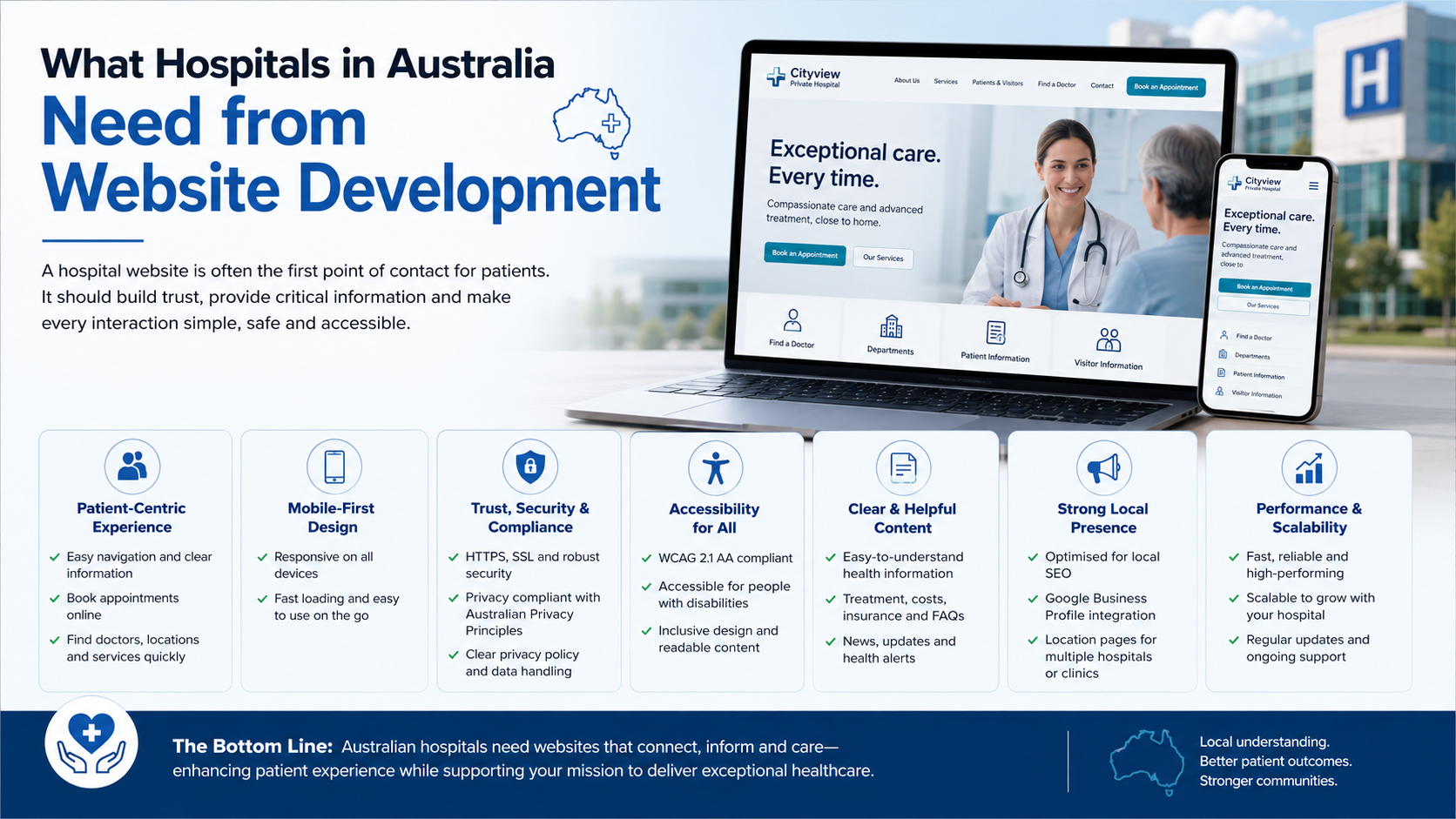
When looking at what hospitals in Australia need from website development, the priorities must shift away from purely aesthetic design toward stability, strict data governance, and frictionless user journeys.
Healthcare platforms operate under immense scrutiny. Between Ahpra compliance, strict patient privacy laws, and the diverse accessibility needs of the Australian public, a generic theme deployment simply will not cut it. Your digital presence requires the same engineering rigor as your physical infrastructure.
Australian healthcare providers operate under the strict oversight of the Privacy Act 1988 and the Australian Privacy Principles (APPs). If your website utilizes basic contact forms or third-party booking integrations that route patient data through unencrypted channels or offshore servers, you are exposed to massive liability.
A professional WordPress developer approaches this problem from the database level up. This means implementing end-to-end encryption, ensuring database storage complies with local data residency requirements, and stripping out bloated third-party scripts that track user behavior without explicit consent.
Security is not a plugin you install and forget; it is an architectural decision. It involves configuring proper content security policies, hardening server environments, and setting up strict role-based access controls so hospital staff only see the data necessary for their specific roles.
When a medical portal slows down, it does more than frustrate users—it actively disrupts care delivery. If an emergency contact page or a specialist directory takes six seconds to load on a patchy mobile network in regional Queensland, that is a functional failure.
High performance relies heavily on optimizing how your site handles data and assets. According to Google’s Core Web Vitals guidelines, metrics like Largest Contentful Paint (LCP) and Cumulative Layout Shift (CLS) directly dictate how usable a site is under poor network conditions.
[Bloated Theme + 40 Plugins] ──> Heavy Server Load ──> 4.5s Load Time (Patient Abandons Page)
[Custom Clean Code + Caching] ──> Efficient Database ──> 0.9s Load Time (Frictionless Booking)
Many web development teams rely on pre-built page builders that load massive JavaScript and CSS libraries for simple layouts. For a hospital site, every line of unnecessary code is a liability.
A medical group came to me with a multi-clinic portal that was taking 4.8 seconds to load. The previous agency had stacked multiple booking plugins and heavy image sliders on the homepage.
By auditing the database, stripping out the conflicting plugins, writing a lightweight custom navigation setup, and properly deferring non-essential scripts, we brought the load time down to 1.2 seconds. More importantly, the clinic saw a 19% increase in completed online bookings within the first month because patients no longer abandoned the slow form.
Most businesses do not realize they have hired a “theme installer” until the website begins to break under moderate traffic or during a core platform update.
| Feature / Capability | Typical Theme Installer Agency | Dedicated Technical Partner |
|---|---|---|
| Development Approach | Modifies a pre-made commercial theme with heavy page builders. | Writes clean, custom code tailored to your exact workflows. |
| Site Speed & Code Quality | Slow; relies on dozens of plugins to achieve basic functionality. | Fast; minimal plugin dependency, optimized database queries. |
| Security & Maintenance | Vulnerable; brittle setups that break during major core updates. | Secure; robust architecture designed for long-term stability. |
| Data Handling | Uses standard forms that may risk data leaks or non-compliance. | Implements encrypted, compliant data routing procedures. |
A hospital website must be accessible to everyone, including the elderly, vision-impaired individuals, and people navigating the site under extreme stress. Meeting the Web Content Accessibility Guidelines (WCAG) is a legal and ethical requirement for Australian healthcare institutions.
True accessibility cannot be achieved by slapping a generic accessibility widget onto a broken website. It must be baked into the underlying codebase.
This requires implementing proper semantic HTML, ensuring full keyboard navigation support, and managing ARIA attributes correctly so screen readers can parse complex medical directories seamlessly. You can review the full breakdown of these technical requirements via the official W3C WCAG specifications.
If you are unsure whether your current platform is up to par, look out for these common red flags:
If your hospital website feels slow, fragile, or is failing to convert visitors into scheduled appointments, this is exactly the type of technical audit and structural rebuilding I provide through my WordPress maintenance services.
Before signing a contract for your next digital project, put your prospective web development specialist to the test with these direct questions:
By asking these questions, you easily filter out casual builders and find a true digital partner who understands the high stakes of healthcare infrastructure.
When evaluating what hospitals in Australia need from website development, the answer always comes down to reliability, compliance, and speed. A hospital site is an essential utility. It must guide patients to the right care effortlessly, protect their personal information rigorously, and scale reliably without constant technical hitches.
Most websites try to impress users. The best ones remove friction. And that difference is what users remember—and what healthcare institutions profit from through increased trust and operational efficiency. If you are ready to transition from a fragile, slow platform to a secure, high-performing digital asset, let’s look at a structured engineering plan tailored to your clinic or hospital group.