A healthcare website is not a digital brochure. When a patient visits a hospital’s platform, they are often stressed, looking for immediate care, or trying to access critical medical records. If the page hangs for five seconds or freezes on a mobile device, that patient leaves. For healthcare providers, a broken user experience directly translates to lost patient trust and dropped appointment bookings.
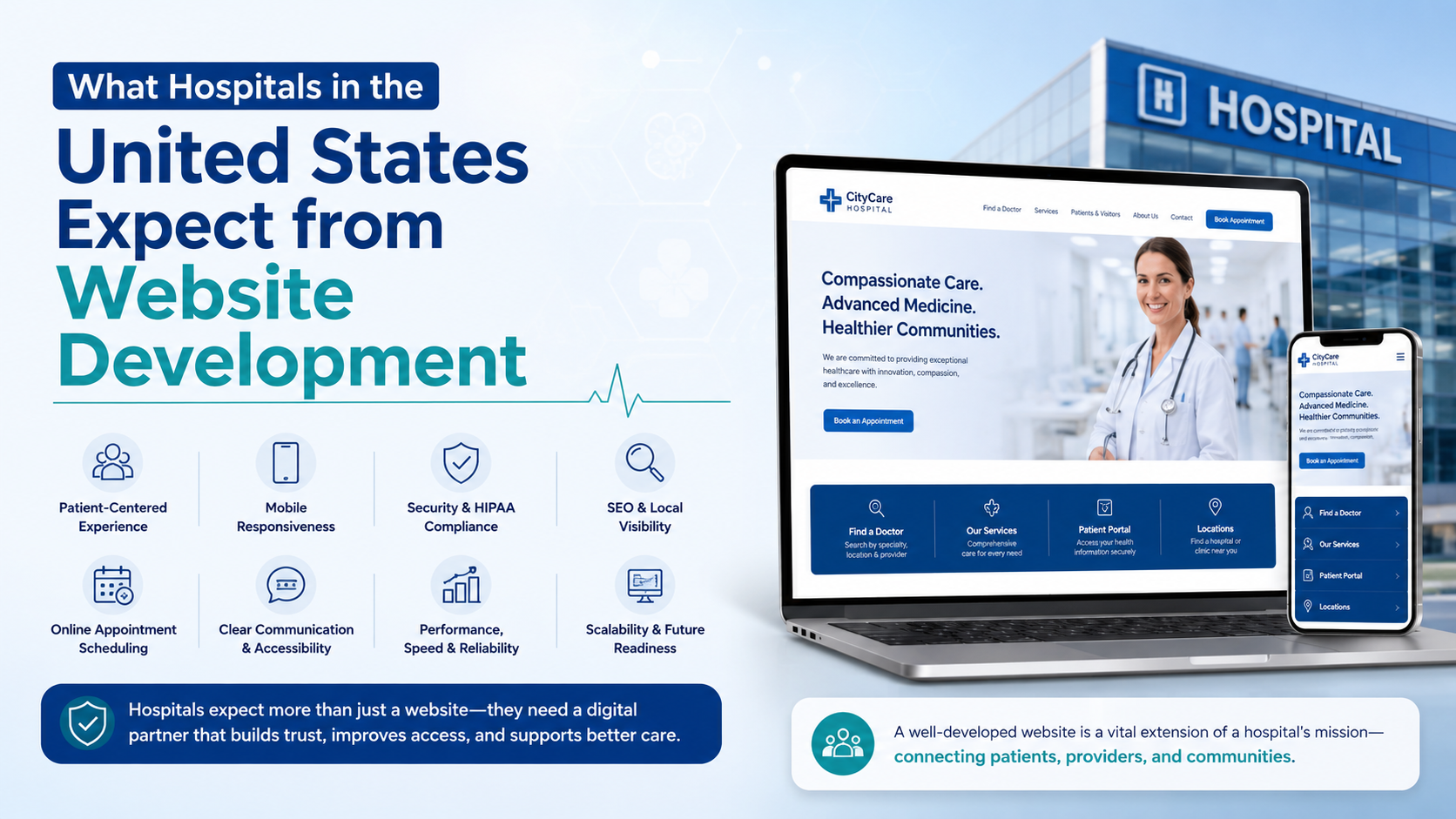
Understanding what hospitals in the United States expect from website development requires looking past superficial design trends. Healthcare institutions operate under strict regulatory frameworks, complex data structures, and the absolute necessity for zero-downtime reliability. They need platforms that serve patients efficiently while protecting sensitive operational data.
When building or auditing these systems, a cookie-cutter template loaded with heavy, unoptimized plugins will not suffice. Healthcare organizations require clean engineering, robust security architecture, and seamless integrations with electronic health record (EHR) systems.
Most generic web builders focus on how a site looks. A technical partner, however, focuses on how the site performs under stress. Healthcare web platforms must balance front-end speed with heavy back-end data processing, such as patient portals and doctor directories.
What hospitals in the United States expect from website development is a system that loads instantly across all regions. Patient accessibility cannot be compromised by bloated code or unoptimized server configurations.
In the United States, healthcare platforms must adhere to strict regulatory standards, including HIPAA compliance for handling patient data. While a front-end developer focuses on colors and layouts, a seasoned WordPress professional ensures that no protected health information (PHI) is ever stored insecurely within the database.
This means forms must securely route data to compliant third-party CRM systems via encrypted APIs rather than storing sensitive entries in default, vulnerable database tables.
Patients frequently look up emergency room locations or urgent care wait times from their mobile devices while on the road. If your technical architecture is sluggish, Google will penalize your search visibility, and users will bounce to a competitor.
[Unoptimized Theme] ---> High Latency ---> Abandoned Sessions
[Clean Core Setup]   ---> Sub-1s Load    ---> Completed Appointments
Following Google’s Core Web Vitals guidelines, websites must maintain a low Largest Contentful Paint (LCP) and minimal First Input Delay (FID). Achieving this requires server-level caching, clean database queries, and a lean asset-loading strategy.
Medical platforms must be usable by everyone, including individuals with visual, auditory, or cognitive impairments. True accessibility cannot be achieved by simply dropping in a cheap JavaScript accessibility widget that slows down the site. It must be coded directly into the core theme architecture.
Hospitals face significant legal risks if their digital platforms fail to meet federal accessibility standards. A proper web development specialist builds with semantic HTML, ensures strict keyboard navigation compatibility, and maintains proper color contrast ratios from day one.
Aligning development workflows with the official W3C WCAG accessibility standards ensures that screen readers can seamlessly parse your patient portals and provider directories without breaking.
Many businesses mistakenly hire agencies that simply install a pre-made medical theme, pile on thirty different plugins to achieve basic features, and hand over a fragile, slow platform.
| Feature | Theme Installer Approach | Custom Developer Approach |
| Codebase | Bloated with unused CSS/JS | Clean, minimalist, and fast |
| Security | High vulnerability via plugin reliance | Hardened core with secure API routing |
| Page Speed | Frequently fails Core Web Vitals | Optimized for sub-second rendering |
| Scalability | Breaks during major core updates | Long-term stability with native functions |
| Integrations | Fragile third-party connectors | Custom, reliable webhook implementations |
Signs your current site was built by a theme installer, not a developer:
A regional healthcare provider approached me with a critical performance issue. Their custom doctor directory, which contained over 400 medical profiles, was taking 5.8 seconds to load. The previous development team had implemented a heavy, plugin-dependent filtering system that triggered dozens of inefficient database queries on every single page refresh.
Before onboarding a digital partner to manage or build a medical platform, decision-makers should vet their technical reasoning. Avoid vague answers and look for concrete engineering workflows.
Crucial Vetting Questions:
- How do you handle database optimization to prevent search latency in provider directories?
- What is your workflow for ensuring the site remains functional when WordPress deploys major core updates?
- Can you demonstrate how you achieve WCAG 2.1 compliance without relying on third-party overlay widgets?
A healthcare website is a living operational tool. It requires regular database optimization, security patching, and code audits to remain secure and efficient. Neglecting these areas leads to silent failures—like broken appointment forms or slow database responses—that quietly drain your marketing budget.
If your platform feels slow, unstable, or is failing to convert visitors into scheduled appointments, this is exactly the type of technical audit and structural restructuring I provide through my custom WordPress development and WordPress maintenance services. Instead of patching symptoms with more plugins, I fix the underlying infrastructure.
Meeting what hospitals in the United States expect from website development comes down to treating your website as core medical infrastructure. It requires a deep commitment to security, compliance, and clean engineering.
Most websites try to impress users. The best ones remove friction. And that difference is what users remember—and what businesses profit from. When your platform works flawlessly, patient trust follows naturally.
If you need an experienced developer to audit your site’s performance, clean up bloated code, or secure your infrastructure, let’s talk. Connect with me directly at thewebfreelancer.com to schedule a technical consultation.