Medical practitioners in Sydney, Melbourne, and Brisbane often realize their website is failing them at the worst possible moment—usually when a prospective patient mentions they couldn’t find the “Book Appointment” button or when the site simply stops loading after a plugin update.
A clinic website isn’t a digital brochure; it is a clinical tool. If it’s slow, hard to navigate, or looks like it was built in 2015, you aren’t just losing clicks—you are losing patient trust. When you begin Clinic Website Budget Planning in Australia, you aren’t just looking for a price tag; you are looking for a functional asset that minimizes friction and maximizes patient intake.
Most Australian clinic owners get trapped between two extremes: the “cheap” $1,500 DIY template that breaks in six months, and the $20,000 “full-service agency” that spends half the budget on account managers rather than actual code.
The biggest hidden cost in any web project is technical debt. This happens when a WordPress professional isn’t involved from the start. Instead, someone installs a heavy “all-in-one” medical theme and dozens of unnecessary plugins to achieve basic features.
Every extra plugin is a potential security hole and a definite performance drag. For a clinic, speed is non-negotiable. If your site takes five seconds to load on a 4G connection in rural NSW, that patient is going to a competitor.
According to Google’s Core Web Vitals guidelines, page experience metrics like “Largest Contentful Paint” directly impact how users perceive your site’s reliability. A site that feels “broken” during the loading phase signals a lack of professional care.
To plan your budget effectively, you need to understand where the money actually goes. A developer-led approach focuses on clean architecture, ensuring your site remains stable as WordPress evolves.
| Feature | Theme Installer (Cheap Option) | Professional WordPress Developer |
| Foundation | Pre-made, bloated template | Lightweight, custom-coded or optimized framework |
| Speed | Depends on “caching plugins” | Built into the code architecture |
| Security | High risk due to “plugin soup” | Hardened at the server and code level |
| SEO | Basic metadata entry | Technical SEO and schema for local clinics |
| Long-term Cost | High (constant fixes needed) | Low (stable, predictable maintenance) |
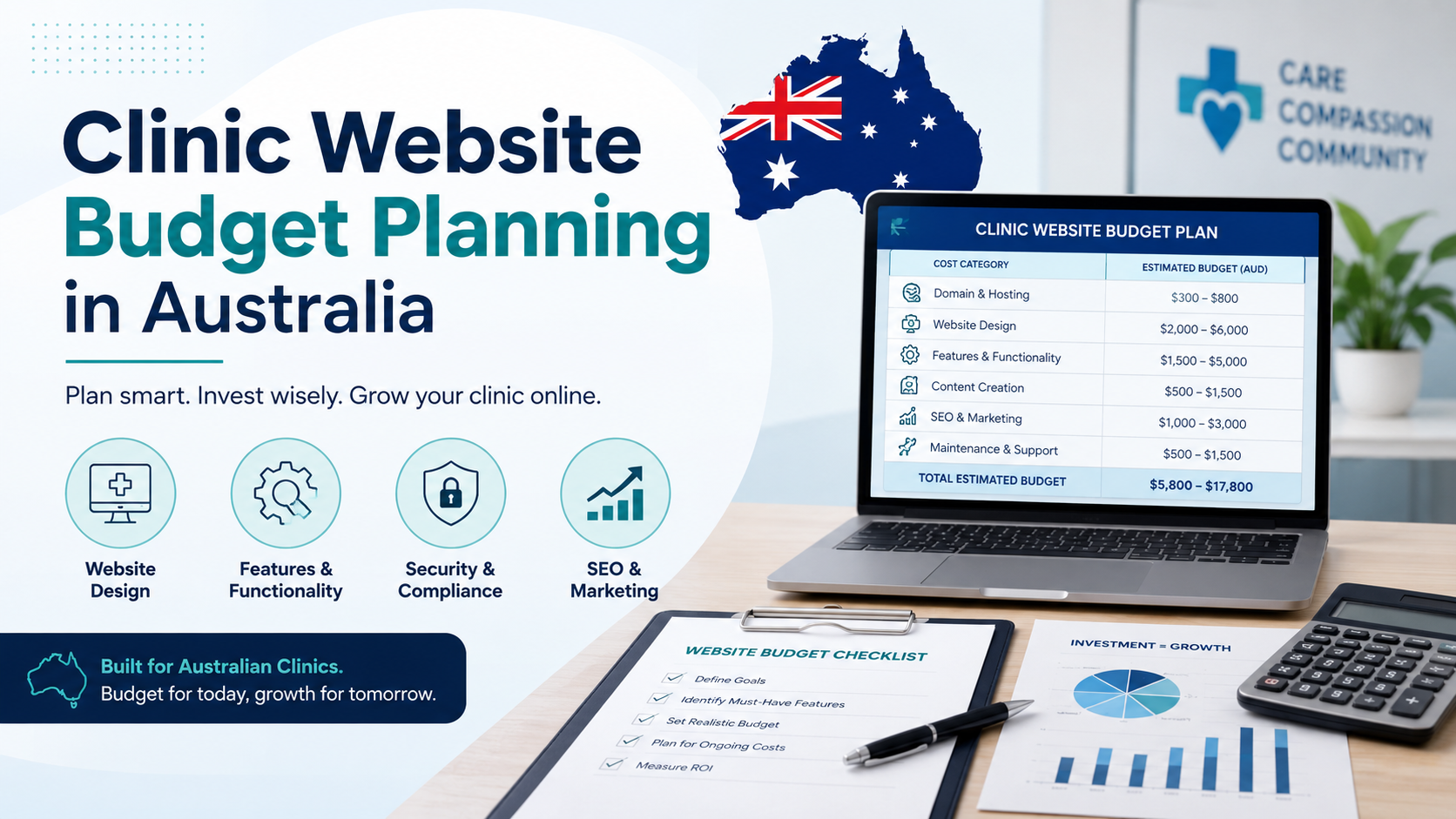
If your budget is spent entirely on “design” without a deep dive into the backend, you are building a house on sand. Clinic Website Budget Planning in Australia must account for high-quality hosting, compliance for sensitive data handling, and a seamless integration with booking systems like HotDoc or HealthEngine.
To give you an accurate baseline for your financial mapping, medical web infrastructure typically scales across three distinct investment tiers:
| Clinic Scale & Complexity | Operational Requirements | Real-World Cost Range (AUD) |
| Boutique / Solo Practice (e.g., Local Physio, Podiatrist) | Local SEO setup, 5–10 core pages, native booking integration, basic contact privacy hardening. | $4,000 – $6,500 |
| Established Medical Centre (e.g., GP Practices, Dental Clinics) | 10–25 pages, custom doctor/staff directories, integrated filtering for specialties, strict data isolation. | $7,000 – $13,000 |
| Multi-Location / Premium Specialist (e.g., Cosmetic Surgery, Radiology) | 25+ pages, custom interactive treatment selectors, advanced speed optimization across asset libraries. | $15,000 – $30,000+ |
If you already have a site and are wondering if it needs a rebuild, check for these clear signs that it was assembled by a theme installer rather than a web development specialist:
I recently worked with a dental clinic in Perth that had a site built by a “digital partner” who used a heavy visual builder for every single element. The site weighed a massive 8MB per page.
The Fix: I audited the site, stripped out the visual builder, and rebuilt the core templates from scratch using a properly coded navigation system and native WordPress blocks.
The Outcome: We reduced the page weight down to 1.2MB. Their organic traffic from mobile users increased by 40% in three months because the site finally met modern search engine performance standards.
In Australia, healthcare providers face rigorous legal scrutiny regarding data. Under the Privacy Act 1988, Australian privacy laws impose strict, mandatory obligations on how health service providers collect, store, and handle personal health information. Because your website is the very first point of data collection, a security breach isn’t just an inconvenience—it’s a massive legal and financial liability.
Budgeting for security involves much more than just a basic “Green Padlock” (SSL certificate). It requires a technical partner who actively follows WordPress.org’s hardening guide to protect your database from malicious injections and ensure your contact or intake forms aren’t leaking sensitive patient data.
As a WordPress developer, I prioritize server-side security protocols over front-end security plugins. A site that has been “cleaned” after a malicious hack is never quite the same; it is far more cost-effective to build the “locks” into the door from day one.
Your clinic survives on appointments. Whether your practice relies on a third-party API or a custom-built workflow, the integration must be completely flawless.
Many budget-rate developers simply iframe a booking link onto a blank page. This is lazy, looks unprofessional on mobile devices, and hurts your SEO. A true developer will ensure the integration is styled natively to match your brand identity and tracks conversions accurately. This allows you to see exactly which marketing channels are driving real revenue.
If your practice also handles retail elements like selling supplements or skincare products, a dedicated WooCommerce website developer can integrate an e-commerce layer that handles transactions without slowing down the critical clinical booking path.
Before you commit your hard-earned budget to any development team, put them to the test with these three questions:
A professional digital partner will have clear, logic-based architectural answers. An agency salesperson will likely give you a generic, rehearsed response.
If your current website feels slow, looks confusing to patients, or simply isn’t converting local traffic into booked appointments, this is exactly the type of technical audit and structural restructuring I provide for my clients. Whether you need a fresh build or a dedicated WordPress speed optimization service, the ultimate goal remains identical: a fast, secure site that works as hard as your medical staff does.
Properly executed Clinic Website Budget Planning in Australia is about more than just aesthetics. It is about engineering a stable, compliant platform that supports your practice’s growth for the next five years, not just the next five months.
Most websites try to impress users. The best ones remove friction. And that difference is what users remember—and what businesses profit from.